This report, titled “Pakistan’s Trade with the European Union (EU) and Its Member States,” is a part of the Pakistan Business Council’s (PBC) Market Access Series 2025-26. The report provides a comprehensive analysis of Pakistan’s trade performance with the EU, both as a bloc and with individual member countries.
The European Union (EU) has its historical origins in the aftermath of World War II when European leaders sought to prevent future conflicts and foster peace and cooperation among European countries.
Combined, the EU is one of the world’s largest economies. The table below lists the top 10 economies of the EU based on gross domestic product (GDP) in 2024. Following Brexit, the UK has not been included in this list.
The EU combined produced $21 trillion worth of goods and services in 2024, accounting for around 17.9 % of the world’s output. The following table shows the top 10 economies within the EU, where Germany has the highest GDP of $4.4 trillion and accounts for 24.0% of the EU economy. Following Germany are France, Italy, Spain, and the Netherlands. The top 10 countries in the EU accounted for 14.4% in the global GDP.
Table 1: Top EU Economies Based on GDP 2024
| Rank |
Country |
GDP 2024 (USD billion $) |
Share in the EU Economy (%) |
| 1 |
Germany |
4,685.5 |
24.0% |
| 2 |
France |
3,160.4 |
16.2% |
| 3 |
Italy |
2,380.8 |
12.2% |
| 4 |
Spain |
1,725.6 |
8.8% |
| 5 |
Netherlands |
1,214.9 |
6.2% |
| 6 |
Poland |
917.7 |
4.7% |
| 7 |
Belgium |
671.3 |
3.4% |
| 8 |
Ireland |
609.1 |
3.1% |
| 9 |
Sweden |
603.7 |
3.1% |
| 10 |
Austria |
534.7 |
2.7% |
| Source: World Bank |
Pakistan’s Trade with the European Union
The EU is a significant trading partner for Pakistan, it unilaterally granted Pakistan GSP+ status in 2014, thereby facilitating preferential access to its common market. The GSP+ has allowed Pakistan to export a wide range of products to the EU market at reduced or zero tariffs, leading to a notable increase in exports, particularly in the textiles and clothing sectors.
Pakistan’s GSP+ status is subject to ongoing review by the European Commission, which assesses the country’s compliance with 27 international conventions related to human rights, labor rights, environmental protection, and good governance.
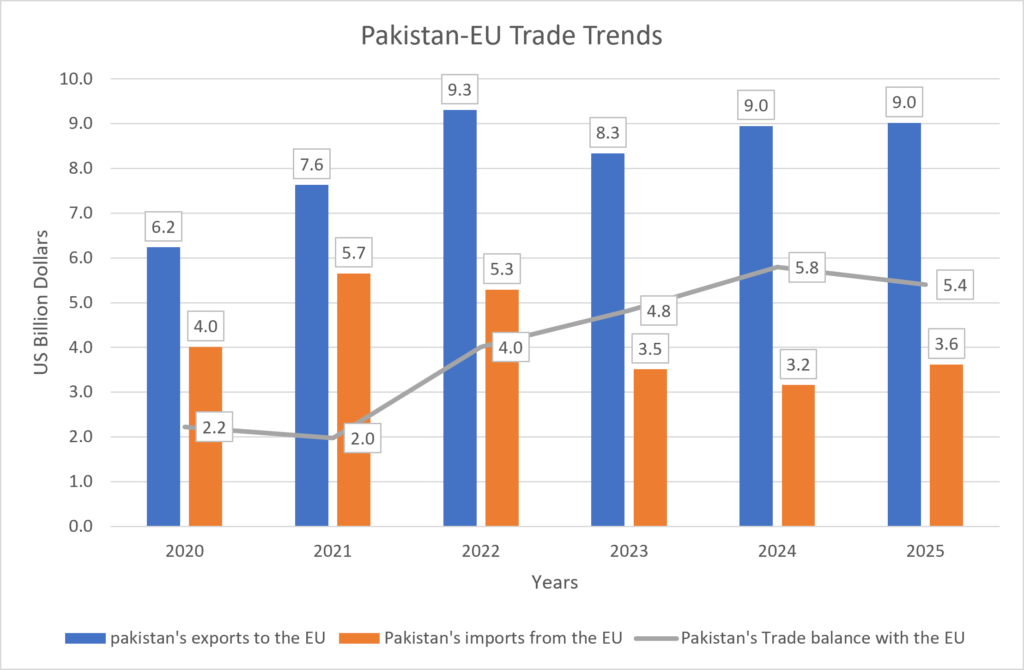
The following figure shows Pakistan’s trade trends with the EU for the last five years. Over the last five years, Pakistan’s trade with the European Union (EU) has seen growth. Total trade between the EU and Pakistan reached $13.6 billion in 2025, making EU Pakistan’s second most important trading partner after China, accounting for approximately 15.0% of Pakistan’s total trade. The EU is the most crucial export destination for Pakistan, with 29.4% of the country’s exports heading to the European market. Conversely, the EU ranks as Pakistan’s sixth-largest import source, with imports of $3.6 billion in 2025.
The GSP+ scheme has facilitated Pakistan’s exports to the EU, with zero import duties applied to 66 percent tariff lines. As a result, Pakistan’s exports to the EU have consistently increased over the years, rising from $5.1 billion in 2015 to $9.0 billion in 2025, making it the largest beneficiary among all GSP+ countries.
The figure below shows Pakistan’s trade trends with the EU region during the period 2021 and 2025.
Figure 1: Pakistan’s Trade Trends with the EU
Source: ITC Trade Map
The table below illustrates the Pakistan’s exports to the European Union for the year 2025. In 2025, the total exports from Pakistan to EU reached approximately $9.0 billion, which represents around 29.4% of the country’s overall exports to the world. Furthermore Germany was the primary destination of exports from Pakistan within the EU, with exports totaling up to $1.68 billion , which constituted to 18.63% of the total exports to the EU, in addition to this, top four destinations for the exports in the EU were Netherlands, Spain, Italy and Belgium.
Table 2: Pakistan Exports to EU Members 2025
| Country |
Pakistan’s Exports (USD Millions) |
Share in Exports (%) |
| European Union (EU 27) Aggregation |
9,020.2 |
29.4% |
| Germany |
1,680.4 |
18.6% |
| Spain |
1,594.3 |
17.6% |
| Netherlands |
1,546.2 |
17.1% |
| Italy |
1,167.0 |
12.9% |
| Belgium |
609.0 |
6.7% |
| France |
518.3 |
5.7% |
| Poland |
448.7 |
4.9% |
| Denmark |
299.1 |
3.3% |
| Portugal |
217.2 |
2.4% |
| Sweden |
175.3 |
1.9% |
| Greece |
151.0 |
1.6% |
| Slovenia |
109.0 |
1.2% |
| Ireland |
99.8 |
1.1% |
| Romania |
87.2 |
0.9% |
| Bulgaria |
48.6 |
0.5% |
| Czech Republic |
46.3 |
0.5% |
| Hungary |
42.4 |
0.4% |
| Lithuania |
40.7 |
0.4% |
| Finland |
30.3 |
0.3% |
| Croatia |
27.7 |
0.3% |
| Slovakia |
20.8 |
0.2% |
| Austria |
18.7 |
0.2% |
| Latvia |
10.6 |
0.1% |
| Cyprus |
10 |
0.1% |
| Estonia |
8.9 |
0.1% |
| Malta |
5.7 |
0.0% |
| Luxembourg |
2.9 |
0.0% |
| European Union Nes |
2.9 |
0.0% |
| Source: ITC Trade Map |
The table below exemplifies Pakistan’s Imports from the EU for the year 2025. In 2025, Pakistan imported approximately $3.6 billion worth of goods, which represents around 5.57% of the total imports in Pakistan from the globe. In the EU, Germany is the primary source of Imports for Pakistan, with goods worth of $846 million, it represented 23.41% of the imports from EU to Pakistan. Moreover, Italy, France, Netherlands and Belgium were amongst the top 5 countries which were a source of imports for Pakistan.
Table 3: Pakistan Imports from EU Members 2025
| Country |
Pakistan’s Imports (USD Millions) |
Share in Imports (%) |
| European Union (EU 27) Aggregation |
3,617.8 |
5.5% |
| Germany |
846.7 |
23.4% |
| Italy |
425.8 |
11.7% |
| France |
366.5 |
10.1% |
| Netherlands |
296.3 |
8.1% |
| Belgium |
249.6 |
6.9% |
| Spain |
239.2 |
6.6% |
| European Union Nes |
179.5 |
4.9% |
| Sweden |
159.1 |
4.4% |
| Denmark |
128.6 |
3.5% |
| Austria |
115.3 |
3.1% |
| Ireland |
104.3 |
2.8% |
| Poland |
99.7 |
2.7% |
| Romania |
82.4 |
2.2% |
| Finland |
59.7 |
1.6% |
| Hungary |
48.8 |
1.3% |
| Greece |
44.2 |
1.2% |
| Czech Republic |
40.7 |
1.1% |
| Portugal |
36.6 |
1.0% |
| Bulgaria |
18.1 |
0.5% |
| Slovenia |
18.0 |
0.5% |
| Lithuania |
15.6 |
0.4% |
| Latvia |
14.0 |
0.3% |
| Slovakia |
10.4 |
0.2% |
| Estonia |
6.5 |
0.1% |
| Luxembourg |
4.4 |
0.1% |
| Cyprus |
3.4 |
0.0% |
| Croatia |
1.8 |
0.0% |
| Malta |
1.4 |
0.0% |
| Source: ITC Trade Map |
The PBC is a private sector not-for-profit advocacy platform set-up in 2005 by 14 (now 100+) of Pakistan’s largest businesses. PBC’s research-based advocacy supports measures which improve Pakistani industry’s regional and global competitiveness. More information about the PBC, its members, objectives and activities can be found on its website: www.pbc.org.pk
Download