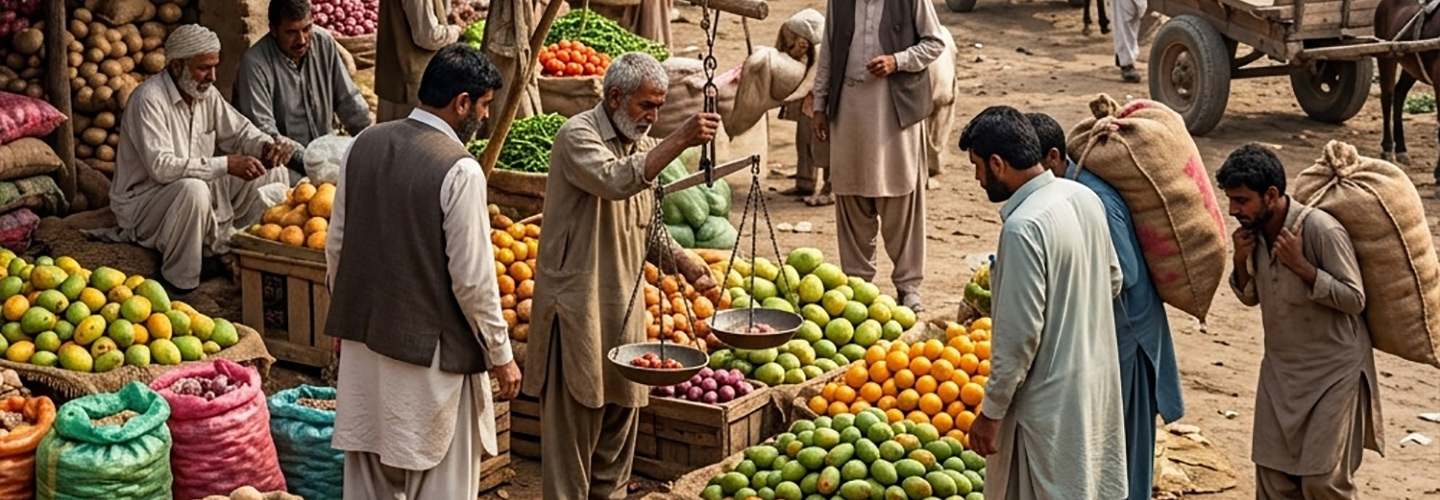
This policy brief titled ‘Transforming Agricultural Markets in Pakistan’ has been completed by The Pakistan Business Council (PBC) as part of “Grow More/Grow Better” pillar of its “Make-in-Pakistan” thrust. This policy brief explores the structure and functioning of Pakistan’s agricultural marketing system, the role of mandis and intermediaries in shaping market outcomes, the structural constraints limiting transparency and efficiency, and the reforms needed to gradually integrate modern storage, finance, and market infrastructure into the existing system to improve farmer incomes and market resilience.
Pakistan’s agricultural marketing system is a complex but functional ecosystem that supports both rural livelihoods and national food supply. At its core are traditional wholesale markets (mandis), intermediaries such as commission agents (aarhtis) and aggregators, and a nascent layer of formal market institutions including warehouse receipt systems and exchange-based trading. While this system is resilient and solves critical problems such as liquidity access, market linkage, and informal enforcement, it also generates inefficiencies, including weak price transparency, inconsistent quality valuation, and limited risk management options for farmers.
Most farmers operate under constraints such as small volumes, lack of storage, and immediate cash needs, often tied to informal credit arrangements with intermediaries. As a result, their bargaining power is limited, and sales decisions are driven more by urgency than price optimization. In mandis, price discovery occurs through rapid, opaque bargaining rather than transparent mechanisms, leading to discrepancies between reported wholesale prices and actual farmer earnings. Intermediaries persist because they bundle essential services—credit, aggregation, logistics, and settlement—which are not yet adequately provided by formal systems.
Market dynamics vary significantly by crop type. Perishables, due to their time sensitivity and lack of cold storage, expose farmers to sharp price volatility and distress selling. In contrast, storable crops such as wheat and rice offer greater potential for improved outcomes through storage and delayed sales, especially when supported by financing mechanisms. Government policy plays a particularly strong role in staple markets like wheat, where procurement and stock management influence price expectations. However, recent shifts toward reduced public procurement and greater private sector participation require credible and stable policy frameworks to succeed.
Efforts to modernize the system have introduced tools such as Electronic Warehouse Receipts (EWRs), enabling farmers to store produce in accredited facilities and access bank financing using stored commodities as collateral. While promising, this formal layer remains limited in scale due to gaps in infrastructure, grading standardization, and financial inclusion.
Key structural challenges include weak price discovery, lack of standardized quality grading, widespread distress selling, reliance on intermediaries, and limited access to formal storage finance. Addressing these requires a phased and integrated reform approach. Priorities include improving transparency and infrastructure in mandis, establishing reliable grading and testing systems, scaling accredited warehousing, expanding EWR-based financing, and reducing policy uncertainty to encourage private investment.
Ultimately, modernization should focus on integrating, rather than replacing, existing systems by unbundling and upgrading the core functions currently performed by intermediaries. A gradual, commodity-specific approach—anchored in better storage, finance, and transparent price signals – can enhance farmer incomes, reduce volatility, and create a more efficient and resilient agricultural market system.
The PBC is a private sector not-for-profit advocacy platform set-up in 2005 by 14 (now 100) of Pakistan’s largest businesses. PBC’s research-based advocacy supports measures which improve Pakistani industry’s regional and global competitiveness.
Download