This study, “REER Dynamics and External Competitiveness of Pakistan,” aims to provide guidance on assessing Pakistan’s recent exchange-rate stability through a real, inflation-adjusted lens rather than relying solely on movements in the nominal PKR-USD rate. As Pakistan continues efforts to stabilize the macroeconomic environment and rebuild external buffers, exchange-rate outcomes have drawn renewed attention. However, evaluating external competitiveness requires moving beyond the bilateral exchange rate and examining the rupee’s value against a broader set of trading-partner currencies, adjusted for inflation differentials.
The study adopts a multilateral framework to analyze REER behavior and its interaction with export performance, inflation differentials, capital flows, and industrial profitability. Pakistan’s historic experience shows that sustained real overvaluation has generally weakened exports, while periods of real adjustment have tended to support competitiveness. This perspective is particularly relevant in an environment where exchange-rate dynamics are influenced not only by trade flows but also by external financing, reserve accumulation, and policy credibility.
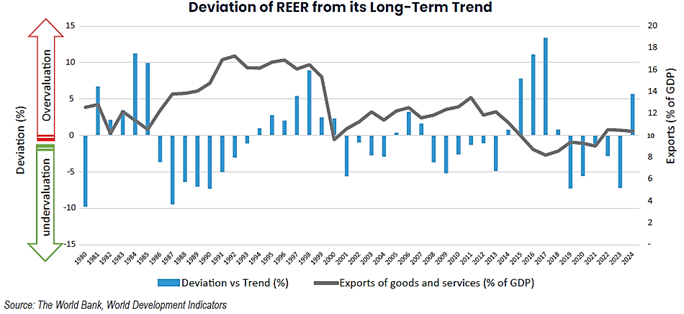
Recent exchange-rate stability has been underpinned by IMF-anchored inflows, bilateral rollovers, strong remittance growth, and improved foreign-exchange market functioning. These factors have helped contain volatility and anchor expectations even as import demand recovered. At the same time, higher domestic inflation relative to trading partners has kept the real exchange rate mildly elevated, indicating that nominal stability has not translated into a corresponding improvement in external competitiveness.
The study situates these trends within Pakistan’s broader macroeconomic context, in which exchange-rate outcomes reflect persistent trade-offs between inflation control, growth, and competitiveness. While reserve accumulation has strengthened short-term buffers and reduced near-term volatility, structural trade imbalances and continued reliance on external financing continue to shape the real exchange rate. Experience suggests that delaying real adjustment increases the risk of abrupt and disruptive corrections.
Overall, the study underscores the importance of distinguishing between nominal exchange-rate stability and real competitiveness when assessing Pakistan’s external position. By focusing on REER dynamics, it provides a clearer framework for understanding how inflation differentials and external inflows influence trade performance and external sustainability over time.
Expert Input and Policy Recommendations
These recommendations, informed by expert input from a prominent Pakistani economist and a former Governor of the State Bank of Pakistan, supported by secondary research, emphasize that exchange-rate management must be complemented by stronger fiscal transparency, reduced reliance on debt-driven inflows, and structural reforms to improve export competitiveness.
Maintain a Market-Based Exchange Rate with Gradual Adjustment
- Support a managed-float regime where market forces determine direction while the SBP smooths excessive volatility.
- A gradual, market-aligned depreciation path should reflect underlying conditions, shifting policy focus toward export-led foreign exchange generation.
Strengthen Transparency of External Liabilities and Fiscal Risks
- Pakistan’s cash-based accounting framework obscures liabilities from SOEs and government guarantees not fully reflected in official figures. Recognizing and consolidating these liabilities is critical for realistic REER assessment and external sustainability analysis.
Adopt a Broader Framework Beyond REER for Policy Assessment
- REER should not be used as a standalone indicator; structural distortions limit its ability to reflect the true equilibrium exchange rate.
- Structural reforms in energy pricing, taxation, logistics, and productivity are essential to support export growth.
Rationalize Domestic Cost Structures to Support Exports
- Higher tariffs on industry raise production costs, offsetting gains from exchange-rate adjustment.
- Reforming subsidy structures, particularly for domestic consumers, addresses cross-subsidization and improves competitiveness more sustainably than depreciation alone.
Allow Exchange Rate Adjustment to Reflect Underlying Fundamentals
- A moderate exchange-rate adjustment (around 5-10%) may be required to align the currency with underlying fundamentals.
Strengthen Trade Facilitation and Global Value Chain Integration
- Competitiveness depends on logistics, cost efficiency, and trade facilitation, not just exchange-rate levels.
- Policy should enable firms to integrate into international production networks and diversify export markets.
Improve Data Transparency and Institutional Capacity
- Ministries lack accurate data on external obligations, with some relying on external agencies for verification.
- Strengthening data systems is essential for credible macroeconomic and exchange-rate policy.
Transition to Accrual-Based Fiscal Accounting
- Shifting from cash-based to accrual accounting will ensure liabilities, including guarantees, are recorded when incurred rather than when paid.
- This will improve decisions related to debt sustainability and exchange-rate management.
The PBC is a private sector not-for-profit advocacy platform set-up in 2005 by 14 (now 100+) of Pakistan’s largest businesses. PBC’s research-based advocacy supports measures which improve Pakistani industry’s regional and global competitiveness. More information about the PBC, its members, objectives and activities can be found on its website: www.pbc.org.pk
Download


