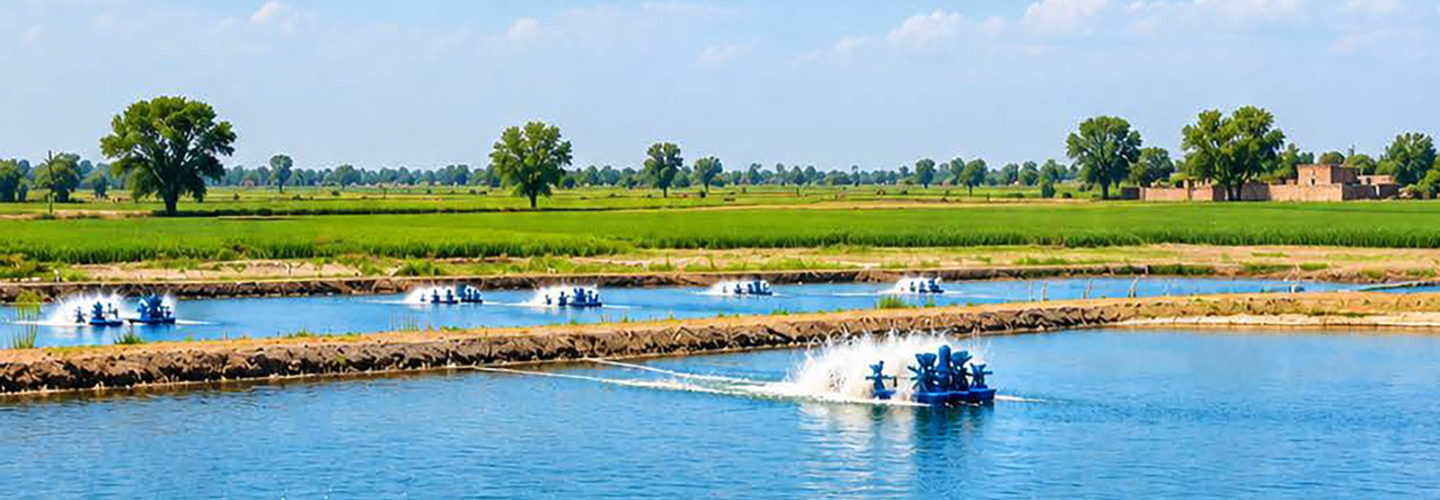
This study, Pakistan’s Aquaculture Sector: Opportunities, Challenges & Policy Recommendations for Improving Export Competitiveness provides a comprehensive assessment of Pakistan’s aquaculture industry, its production systems, value chains, competitiveness, and investment prospects. The analysis examines production trends, regional performance, key constraints affecting productivity, emerging opportunities across the aquaculture value chain, and the potential for strengthening domestic supply and export competitiveness.
Aquaculture is defined as “the farming of aquatic organisms, including fish, molluscs, crustaceans, and aquatic plants. Farming implies some form of intervention in the rearing process to enhance production, such as regular stocking, feeding, protection from predators, etc. Farming also implies individual or corporate ownership of the stock being cultivated. For statistical purposes, aquatic organisms which are harvested by an individual or corporate body which has owned them throughout their rearing period contribute to aquaculture, while aquatic organisms which are exploitable by the public as a common property resource, with or without appropriate licenses, are the harvest of fisheries.”
Aquaculture offers Pakistan an opportunity to diversify agricultural production, strengthen food security, generate rural employment and expand value-added exports. However, the sector remains underdeveloped relative to regional competitors, with low productivity, limited technology adoption and fragmented value chains constraining its potential.
Pakistan’s Aquaculture Sector: Key Indicators
| Indicator |
Key finding |
| Aquaculture production (2024) |
Approximately 174,338 metric tons |
| Production growth (2011–2024) |
22.8% |
| Average aquaculture yield |
3–5 MT per hectare per year |
| Regional productivity benchmark |
Vietnam: 10–15 MT per hectare per year |
| Annual per-capita fish consumption |
Approximately 1.35 kg, against a global average of 19.93 kg |
| World total aquaculture production |
42.8 million metric ton |
| Global seafood trade |
USD 184 billion |
Seafood Export Value Comparison 2025
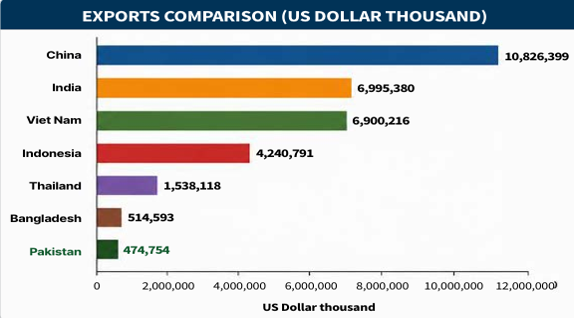
Drawing on national and international data, regional comparisons and majorly stakeholder consultations, this report assesses the sector’s production systems, value chains, trade opportunities and investment potential.
Key Constraints faced by Sector:
- Seed quality: Weak broodstock management, inconsistent seed quality and limited domestic shrimp hatchery capacity.
- Low productivity: Limited adoption of improved farming practices and modern practices and use of the latest technologies.
- High input costs: Expensive feed and underdeveloped commercial aquafeed production.
- Disease and water management: Limited diagnostics, weak biosecurity and climate-related production risks.
- Limited financing: Inadequate access to aquaculture-specific credit and insurance.
- Weak value chains: Insufficient cold storage, processing infrastructure and direct market linkages.
- Export barriers: Gaps in traceability, certification, food safety and international standards.
- Institutional gaps: Inadequate production data, applied research and inter-agency coordination.
Recommended Policy Actions
- Improve national coordination: Establish a national aquaculture framework with common standards and provincial implementation.
- Upgrade seed and feed systems: Strengthen hatchery certification, broodstock management and domestic aquafeed development.
- Raise productivity: Expand farmer extension, demonstration farms and appropriate technology adoption.
- Manage production risks: Improve disease surveillance, water management, climate resilience and access to insurance.
- Mobilize investment: Develop suitable financing and risk-sharing mechanisms for farmers and investors.
- Strengthen value chains: Invest in cold-chain logistics, processing facilities and stronger producer–buyer linkages.
- Improve export readiness: Expand laboratory testing, traceability, certification and access to international markets.
- Build sector capacity: Improve production data, applied research and consumer awareness.
- Promote JVs: Remove hurdles in creating JVs in the sector both on the production as well as export marketing side
Policy Direction and Investment Outlook
Pakistan should priorities productivity, farm profitability and value-chain integration before expanding production at scale. A phased, cluster-based strategy can support investment in inland shrimp farming, hatcheries, aquafeed, modern production systems, cold-chain logistics and certified processing.
The private sector should lead commercial investment and market development, while government focuses on policy certainty, standards, infrastructure, research, extension and appropriate risk-sharing.
A coordinated approach can help transform aquaculture into a more productive and commercially competitive sector, contributing to rural livelihoods, food security, agricultural diversification and export growth.
The PBC is a private sector not-for-profit advocacy platform set-up in 2005 by 14 (now 100+) of Pakistan’s largest businesses. PBC’s research-based advocacy supports measures which improve Pakistani industry’s regional and global competitiveness. More information about the PBC, its members, objectives and activities can be found on its website: www.pbc.org.pk
Download