This study, Identifying Potential Opportunities for Enhancing Pakistan’s Export Growth and Diversification, provides a comprehensive assessment of Pakistan’s export structure, competitiveness, and diversification prospects across major international markets. The analysis examines the composition of Pakistan’s exports, market concentration, export reach, product complexity, export potential, competitiveness, and diversification opportunities at the product and destination level.
The study identifies significant unrealized export opportunities across a broad range of sectors and markets. It evaluates Pakistan’s existing export strengths, highlights areas where exports remain below potential, and identifies new product categories that could support diversification and long-term export growth. The findings aim to support policymakers, businesses, and trade institutions in designing more targeted export promotion strategies and strengthening Pakistan’s integration into global markets.
Pakistan’s Export Structure Remains Highly Concentrated
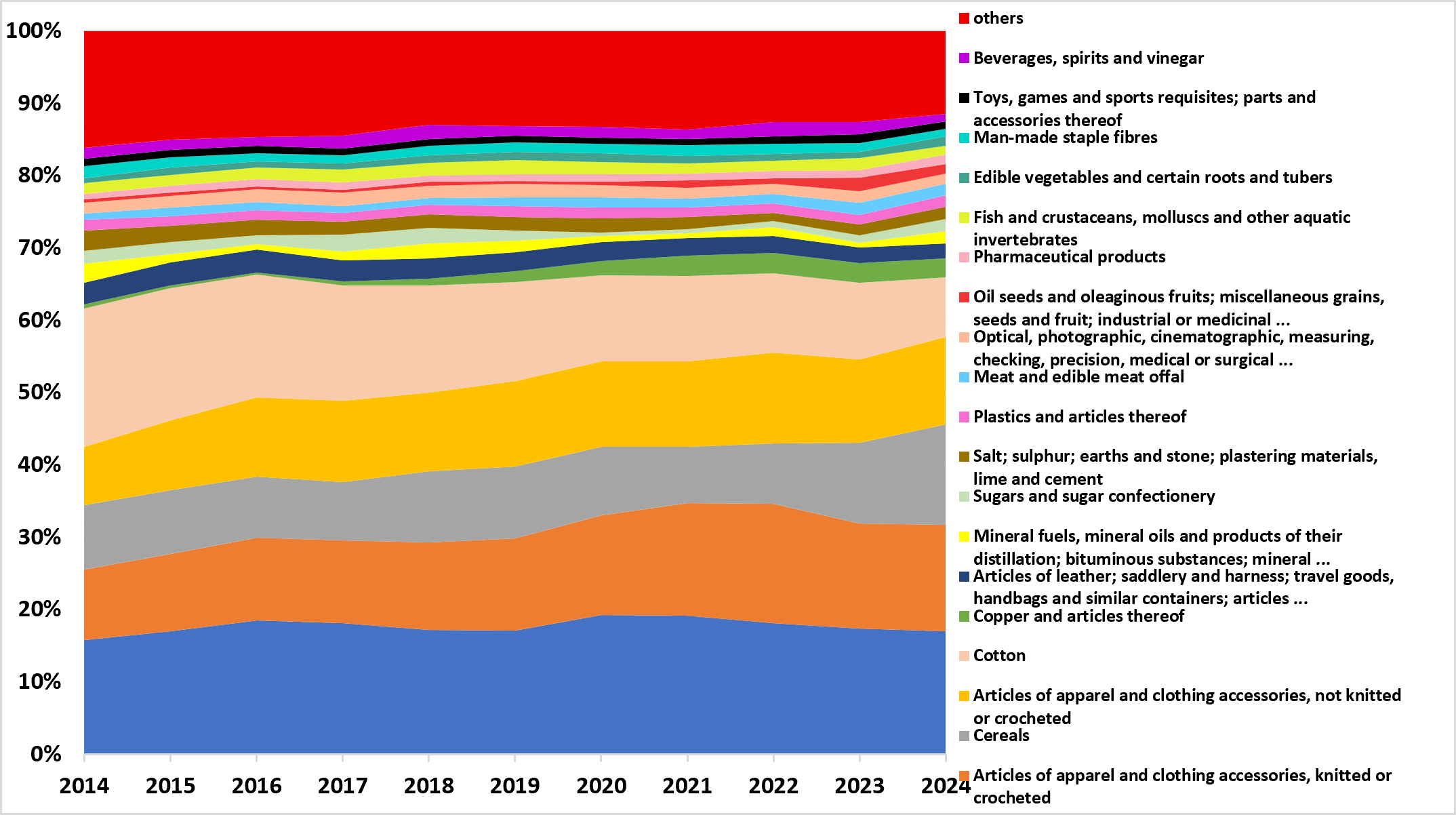
Pakistan’s export basket continues to be dominated by a limited number of sectors, particularly textiles and apparel, along with selected agricultural products. While these sectors remain important sources of export earnings, the high concentration of exports increases vulnerability to external demand shocks, price fluctuations, and changes in global market conditions. The analysis highlights the need to broaden the export base and reduce dependence on a narrow range of products.
Figure 1: Distribution of Pakistan’s Exports Across Sectors
Source ITC
Pakistan Lags Behind Regional Competitors in Export Diversification
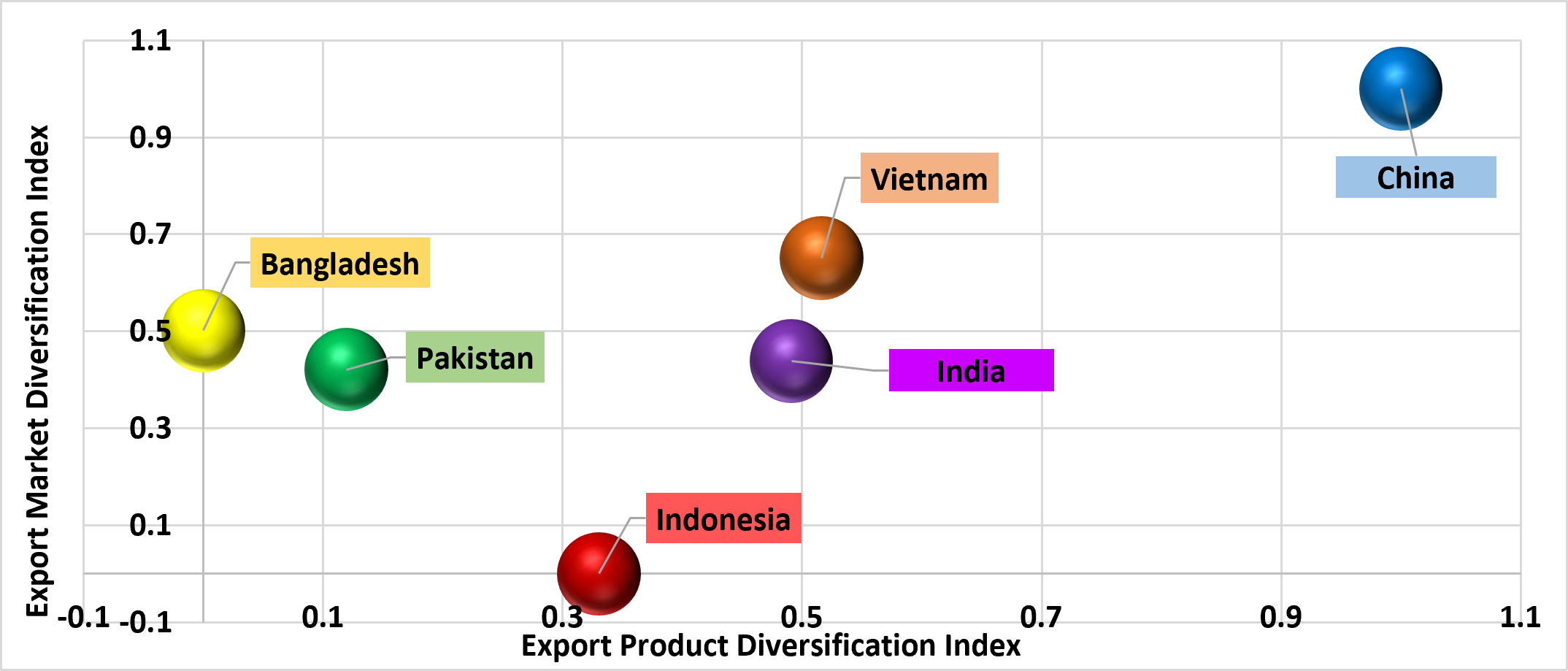
A comparison with major Asian economies shows that Pakistan’s export diversification remains relatively limited. Countries such as China, Vietnam, and India have developed broader export baskets and stronger participation in diversified global value chains. Pakistan continues to rely on a narrower range of products and demonstrates lower product diversification, restricting its ability to capture emerging opportunities in global trade.
Figure 2: Comparative Overview of Export Diversification Performance
Source ITC
Export Diversification and Competitiveness Opportunities
The study identifies significant opportunities to diversify Pakistan’s exports beyond its traditional export base. Promising prospects exist in industrial and intermediate goods, chemicals, plastics, fertilizers, processed foods, fisheries, fruits and vegetables, construction materials, light manufacturing, and selected consumer products.
Developed markets offer high-value opportunities but require greater compliance with international standards, stronger quality assurance, and higher levels of product differentiation. In contrast, regional and emerging markets provide relatively easier access for price-competitive products and intermediate goods.
The competitiveness analysis shows that Pakistan has an established presence in several export categories but remains concentrated in lower and middle-value segments. In most developed markets, Pakistan’s competitiveness is driven primarily by cost advantages rather than branding, innovation, or quality positioning.
Strengthening value addition, product upgrading, branding, and quality enhancement will be essential for improving competitiveness, expanding market penetration, and achieving sustainable export diversification.
Challenges
Infrastructure and Logistics Constraints
Weak transport infrastructure, inefficient logistics systems, and high trade costs continue to undermine export competitiveness. Port inefficiencies, inadequate warehousing facilities, limited cold-chain infrastructure, and reliance on road transport increase shipment costs and reduce the reliability of export supply chains, particularly for high-value and time-sensitive products.
Low Productivity and Limited Value Addition
Pakistan’s exports remain concentrated in low-to-medium value segments, reflecting persistent productivity challenges and limited product upgrading. Weak industrial efficiency, low technological adoption, and insufficient investment in branding, innovation, and quality enhancement constrain the country’s ability to compete in higher-value international markets.
Regulatory and Institutional Inefficiencies
Complex regulatory procedures, weak institutional coordination, and high compliance costs increase the cost of doing business and discourage export expansion. Small and medium-sized enterprises (SMEs) are particularly affected by limited access to formal finance, cumbersome procedures, and difficulties in meeting international standards and certification requirements.
Macroeconomic Instability and Policy Uncertainty
Recurring macroeconomic imbalances, exchange rate volatility, inflationary pressures, and rising production costs create uncertainty for exporters and investors. Frequent policy changes and inconsistent implementation further weaken long-term business planning and reduce confidence in export-oriented investments.
Weak Integration into Global Value Chains
Pakistan remains insufficiently integrated into regional and global production networks. Limited participation in higher value-added stages of production, weak linkages with multinational supply chains, and low export sophistication continue to restrict opportunities for sustained export growth and diversification.
Recommendations
Targeted Export Diversification
Reducing export concentration requires a shift from broad sector-based support toward product-specific export promotion. Priority should be given to products and sectors with demonstrated export potential, particularly processed foods, fisheries, pharmaceuticals, chemicals, light manufacturing, and selected industrial products.
Upgrading Competitiveness and Value Addition
Improving competitiveness will require greater focus on product quality, innovation, branding, certification, and value addition. Strengthening Pakistan’s position in higher-value market segments can enhance export earnings and reduce dependence on price-based competition.
Improving Trade Facilitation and Logistics
Investments in transport infrastructure, logistics services, customs modernization, and trade facilitation measures are essential to reduce export costs and improve supply chain efficiency. Better logistics performance can enhance market access and strengthen Pakistan’s competitiveness in international markets.
Strengthening Market Intelligence and Export Promotion
More effective trade intelligence systems are needed to align export products with market-specific demand. Enhanced use of product-level analysis, buyer networks, trade promotion activities, and market information platforms can improve export penetration and support diversification efforts.
Download