

What is at Stake? Pakistan’s EU GSP+ After 2027
Pakistan’s GSP+ access is at a greater risk than at any time since it was unilaterally granted to Pakistan in...
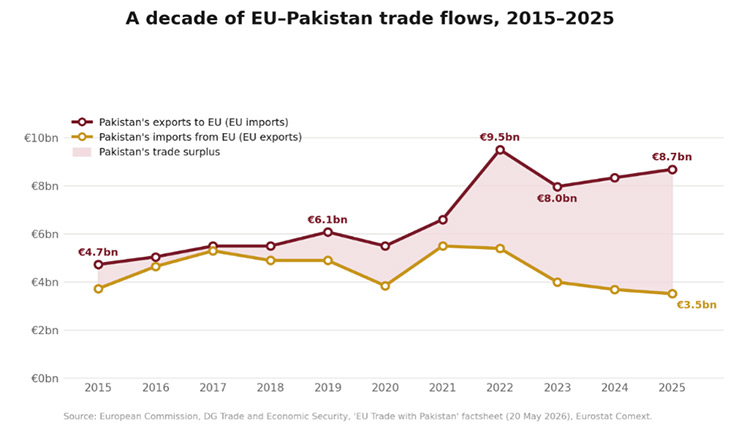
Pakistan’s GSP+ access is at a greater risk than at any time since it was unilaterally granted to Pakistan in 2014. Under the new GSP Regulation (2026/1395), Pakistan must reapply for continuation of its current GSP+, before the end of 2028 and also needs to implement 32 conventions instead of the current 27. It has been forcefully stated that going forward Pakistan will be judged on implementation, not just ratification. The EU bought 29.8% of Pakistan’s exports (€8.7 billion in CY 2025), out of which 70% were textiles and apparel. Without GSP+ these goods would face duties of 9.6% under the standard GSP, or 12% if all preferences were suspended and Pakistan faced the normal MFN tariffs.
Pakistan in 2026, has less leverage than when it was first awarded the GSP+ status. In 2013 it was a vital supply route for NATO forces in Afghanistan; today it must create new value for the EU, this can include granting the EU access to its critical minerals. This is an important point and Pakistan needs to understand that just relying on compliance alone may not be sufficient.
 Background to GSP+
GSP+ is the most generous tier of the EU’s Generalised Scheme of Preferences. It removes duties on roughly two-thirds of EU tariff lines for vulnerable developing countries that effectively implement core conventions on human rights, labour rights, the environment and good governance. The EU grants it unilaterally and reserves the right to withdraw it if compliance lapses.
Pakistan has held GSP+ status since 1st January 2014 and is the scheme’s largest beneficiary by trade value. Its exports to the EU grew 83%, from €4.7 billion in 2015 to €8.7 billion in 2025.
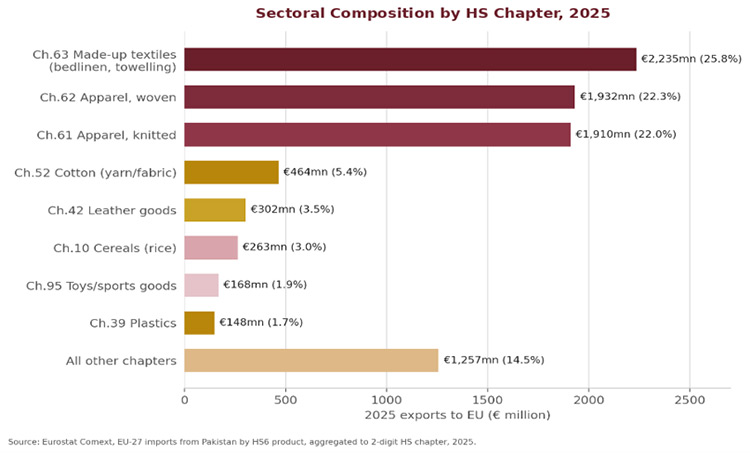
Pakistan’s EU exports are highly concentrated. Knitted apparel, woven apparel and home textiles (HS 61–63) account for €6 billion, or 70% of the total. The top 10 product lines make up 48.5%, and cotton trousers alone 11.3%.
After 2027, three outcomes are possible:
| Scenario | Status | Textile and apparel duty |
|---|---|---|
| A. Reapplication approved | GSP+ retained | 0% |
| B. Reapplication fails or is delayed | Standard GSP | 9.6% |
| C. Serious violations or suspension | MFN | 12% |
A few sectors are cushioned. Basmati rice enters duty-free under separate WTO rules. Medical and surgical instruments (MFN up to 2%) and sporting goods (3%) would see only small increases in tariffs. For Pakistan’s core textile exports, however, even Standard GSP would wipe out much of the price advantage.
Pakistan has ratified all 32 conventions, but the European Commission’s 2023–2025 review finds that “most progress is of legislative and administrative nature and needs to be translated into real improvements on the ground”. Environmental and governance conventions show substantial compliance. The identified gaps are concentrated in two areas:
The pressure on Pakistan is rising. In April 2026, the EU Ambassador to Pakistan said continued access is “neither guaranteed nor automatic”. In July 2026, the European Parliament warned that failure to implement commitments “should result in the withdrawal of Pakistan’s GSP+ status”.
The EU has withdrawn trade preferences for non-compliance thrice in the past. Each case holds lessons for Pakistan.
| Country | What happened | Lesson for Pakistan |
|---|---|---|
| Sri Lanka (GSP+ withdrawn 2010, restored 2017) | Withdrawn for failing to implement UN conventions on torture, children’s rights, and civil and political rights. Export growth was stagnant but did not collapse: under standard GSP they grew from €1.7 billion (2009) to €2.5 billion (2016). | The EU judge’s compliance. Refusing to cooperate weakens a country’s case, and promises made to regain access are monitored for years. |
| Belarus (standard GSP withdrawn 2007) | A trade union complaint led to an investigation into violations of freedom of association. About 10% of EU exports were affected. | Civil society can trigger a review through the EU’s Single-Entry Point. Politics shapes the outcome alongside compliance. |
| Myanmar (standard GSP withdrawn 1997–2013) | Suspended in 1997 for the serious and systematic use of forced labour, as part of wider Western sanctions against the military government. | Preferences are restored only after independent verification of real change, and even then, as Myanmar’s case illustrates, lost trade can take years to recover. |
EU buyers compare Pakistan mostly with Bangladesh, Vietnam, India and Turkey. Of these, Pakistan is in the most vulnerable position: its duty-free access is the only one that depends on passing regular EU reviews and can be taken away.
| Country | Basis of EU access | Textile duty, 2026 | Outlook, 2029 |
|---|---|---|---|
| Turkey | EU Customs Union | 0% | 0%, secure |
| Vietnam | EU–Vietnam FTA (2020) | 0% | 0%, secure |
| Pakistan | GSP+ | 0% | 0%, or 9.6% or 12% if downgraded |
| Bangladesh | Everything But Arms | 0% | 0% if UN approves graduation deferral from LDC, otherwise 12% after transition |
| India | MFN | 12% | 0% once the EU–India FTA takes effect (expected 2027–2028) |
The EU–India FTA is the biggest new threat. It will remove the 12% duty that Indian textiles currently face, ending Pakistan’s tariff advantage over its largest regional competitor.
GSP+ has underpinned a decade of export growth to the EU, but Pakistan cannot treat its renewal as automatic. The strategic conditions that helped secure it in 2013 no longer exist, the EU’s bar is rising, and competitors are locking in permanent duty-free access. Pakistan has limited time to show real implementation and to offer the EU a partnership which is mutually beneficial. Work needs to start now!
The PBC is a private sector not-for-profit advocacy platform set-up in 2005 by 14 (now 100+) of Pakistan’s largest businesses. PBC’s research-based advocacy supports measures which improve Pakistani industry’s regional and global competitiveness. More information about the PBC, its members, objectives and activities can be found on its website: www.pbc.org.pk
DownloadTelephone: 021-35630528-29
Fax: 021-35630530
