This study, “Unlocking the Potential of Pakistan’s Other Business Services Exports: Accounting, Auditing, Bookkeeping and Tax Consulting Services”, is a part of the PBC’s series on the services sector. The first report on Other Business Services was published in June 2022. This is a follow-up report on Classification 10, Other Business Services and specifically focus on 10.2.1.2, Accounting, auditing, bookkeeping, and tax consulting services.
Global Other Business Services Trade
Globally, Classification 10, Other business services were the most exported services in the world with its exports reaching $2.1 trillion in 2024). The Classification 10, Other business services maintained a healthy 7.4% CAGR over the 10-year period (2015–2024), its growth surged to 8.0% during the 6-year period (2019–2024). The U.S.A. was the top exporter of Classification 10, Other business services in 2024, exporting a value of $263.9 billion and having a market share of 12.5%. Both the U.S.A. and the U.K. held about 23.6% of the global market share in 2024.
Pakistan’s Other Business Services Trade
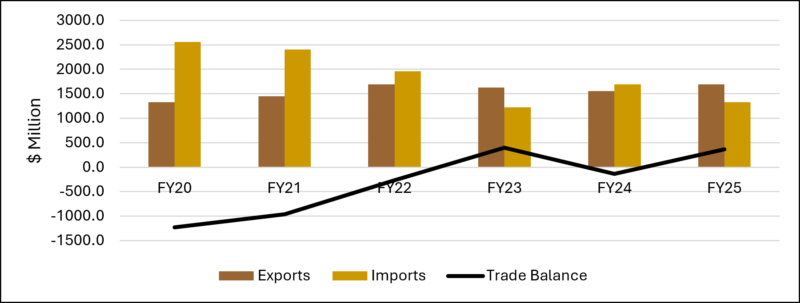
Pakistan’s Classification 10, Other business services exports amounted to $1,573.0 million in 2024. Classification 10, Other business services were Pakistan’s second most exported commercial services in 2024. Classification 10, Other business services’ exports have shown a steady upward trajectory, growing from $1,340 million (FY20) to $1,693.5 million (FY25).
Pakistan’s Other Business Services Trade Scenario from FY20 to FY25
Source: SBP (2026 b)
Pakistan’s export market for Classification 10, Other business services is dominated by 4 countries which make up about 55.4% of the total share of Pakistan’s exports of Classification 10. China is Pakistan’s biggest import partner constituting 19.0% of Pakistan’s total Classification 10, Other business services imports.
Pakistan’s Accounting, Auditing, Bookkeeping and Tax Consulting Services
Pakistan’s accounting services market is a rapidly expanding sector driven by a high demand for BPO and strict regulatory compliances. Leveraging a tech-savvy and technically competent workforce, local firms offer global cost savings of up to 50% through IFRS-compliant services, bookkeeping, and tax preparation.
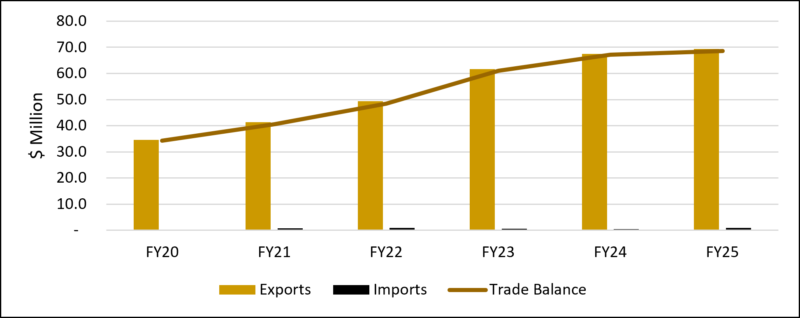
Within Pakistan’s Other Business Services exports, Accounting, Auditing, Bookkeeping, and Tax Consulting services generated approximately US$69.2 million in FY25, recording a 15.0% CAGR between FY20 and FY25. The sector also maintains a strong and persistent trade surplus, reflecting its potential as a source of foreign exchange earnings and higher-value services exports.
Accounting, Auditing, Bookkeeping and Tax Consulting Services Trade Scenario from FY20 to FY25
Source: SBP (2026 b)
Main Findings
Current Market Trends and Future Projections
Strong export growth driven by rising global demand; though continued success increasingly depends on expertise and quality rather than cost alone. Domestic market remains constrained by low fees and high taxes. Demand persists for entry-level finance services but job-ready talent is scarce. AI will automate routine functions, making higher-value advisory and compliance capabilities essential.
Human Capital and Talent Retention Challenges
Graduates lack practical skills, communication abilities, and tech familiarity. Visa restrictions hinder international service delivery. High personal income taxes push skilled professionals toward Gulf & and other markets.
Market Access, Visibility, and International Positioning Constraints
Marketing restrictions limit international visibility. Pakistan is perceived as a low-cost outsourcing hub rather than a quality services provider. Most business is generated through referrals and diaspora networks, making client acquisition difficult for new entrants.
Technology, Infrastructure, and Digital Competitiveness Constraints
Power and internet disruptions undermine client confidence. Weak data protection frameworks reduce international trust. Complex forex procedures and high software costs further limit competitiveness, particularly for SMEs.
Regulatory, Taxation, and Business Environment Challenges
Regulatory complexity discourages foreign investment. Major international accounting firms have exited the market. Fragmented provincial tax regimes and administrative burdens reduce competitiveness.
Weak Institutional Support and Commercial Facilitation
No unified export promotion body exists. Embassies and commercial missions provide limited support. Reliable sector data is absent, and the sector lacks recognition as a strategic export category.
Recommendations
Develop Human Capital and Retain Talent Modernize curricula through industry-academia collaboration, offer tax relief for employees in export-oriented firms, and create industry-led certification programs in bookkeeping, payroll, and compliance support.
Enhance International Market Access and Commercial Diplomacy Run targeted international branding campaigns, leverage embassies for business development, and prioritize expansion into Gulf, UK, Australia, and selected European markets.
Accelerate Technology Adoption and Digital Competitiveness Streamline forex procedures and subsidize professional software, promote AI and cloud adoption, and enact data protection and cybersecurity legislation.
Strengthen the Business Ecosystem Grow domestic demand for outsourced services, shift firms toward higher-value BPM and GCC models, and develop dedicated business services hubs with reliable infrastructure.
Improve the Regulatory and Business Environment Simplify and harmonize provincial tax regimes, streamline forex procedures, and address barriers that discourage international firms from operating in Pakistan.
Provide Institutional Support for Professional Services Recognize the sector as a standalone export category, establish a dedicated export promotion framework, and create a national professional services directory to connect firms with international clients.
The PBC is a private sector not-for-profit advocacy platform set-up in 2005 by 14 (now 100+) of Pakistan’s largest businesses. PBC’s research-based advocacy supports measures which improve Pakistani industry’s regional and global competitiveness. More information about the PBC, its members, objectives and activities can be found on its website: www.pbc.org.pk
Download