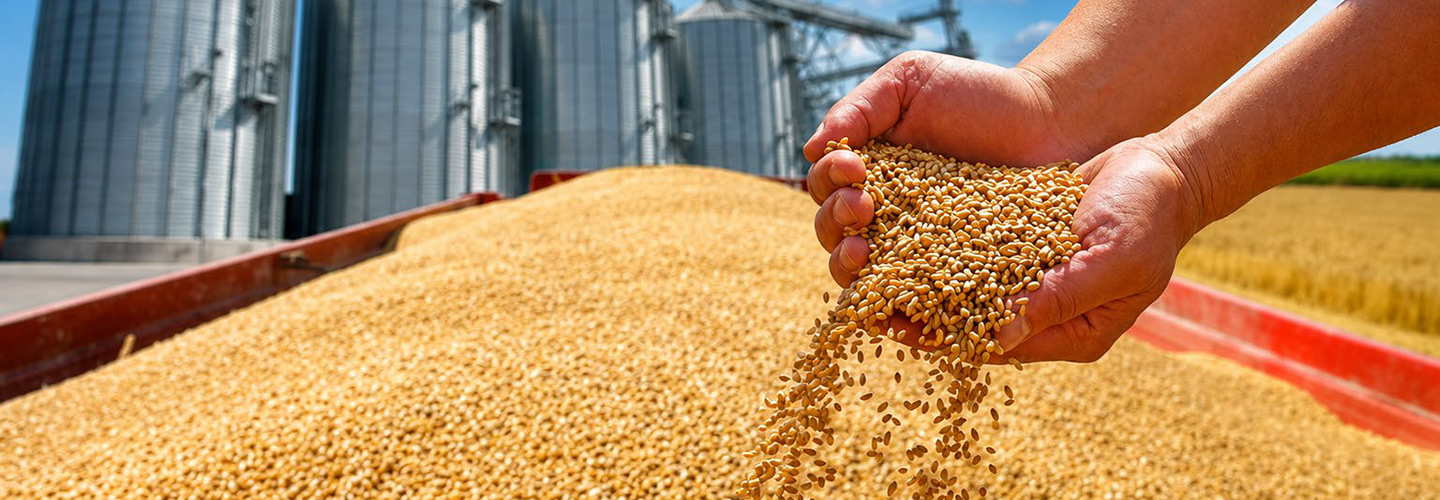
This policy brief titled ‘Grain without Shelter: Pakistan’s Post-Harvest Storage Crisis and the Path Forward’ has been completed by The Pakistan Business Council (PBC) as part of “Grow More/Grow Better” pillar of its “Make-in-Pakistan” thrust. This policy brief explores the structural weaknesses in Pakistan’s grain storage and warehousing system that result in over $1.3 billion in annual post-harvest losses, market instability, and reduced farmer incomes despite adequate crop production. It examines the limitations of traditional farm-level storage, outdated public-sector facilities, and the inefficiencies of the bag-based supply chain, while assessing the potential of modern warehousing, silo infrastructure, and Electronic Warehouse Receipts (EWRs). The brief proposes a market-oriented reform agenda to expand commercial storage, improve access to finance, reduce losses, and build a more efficient and resilient grain value chain.
Pakistan’s agricultural sector, contributing 24% to GDP and employing 37% of the labour force, produces adequate quantities of major crops such as wheat, rice, and maize. However, recurring grain shortages, price volatility, and import dependence stem not from production shortfalls but from systemic inefficiencies in storage and distribution. Post-harvest losses exceed $1.3 billion annually, highlighting structural weaknesses that undermine food security, fiscal stability, and farmer incomes.
The storage ecosystem is fragmented and outdated. Around 60% of wheat is stored at the farm level using traditional methods such as jute bags, mud bins, and open-air ganjis, exposing grain to pests, moisture, and contamination. Public-sector storage, managed by PASSCO and provincial food departments, is both insufficient and deteriorating, with limited capacity for modern practices like temperature control and effective fumigation. While modern silo storage exists, it is largely confined to private processors and remains inaccessible to farmers and small traders.
A key structural inefficiency lies in the bag-based supply chain, where grain is repeatedly packed, unpacked, and transported. This leads to high handling costs and losses, estimated at $1.5 billion annually in Punjab alone. Transitioning to bulk handling and modern warehousing could reduce these costs by up to 65%, offering significant efficiency gains.
Smallholder farmers, who dominate the sector, bear the greatest burden. Lacking storage and access to finance, they are forced into distress sales immediately after harvest when prices are lowest. This dynamic shifts value to intermediaries, particularly aarhtis, who provide credit and storage at high implicit costs. The absence of formal storage and financing mechanisms limits farmers’ ability to benefit from price fluctuations.
Efforts to modernize the system through Electronic Warehouse Receipts (EWRs) present a viable solution. EWRs allow farmers to store produce in accredited facilities and access bank financing, reducing distress sales. Institutional progress, including PMEX’s acquisition of Naymat Collateral, has strengthened the link between commodity markets and storage. However, expansion remains constrained by regulatory risks, especially anti-hoarding laws, and the limited inclusion of wheat in the EWR system.
The shift from a government-led storage model to a market-based system has been uneven. Historically, public procurement under the minimum support price regime dominated but proved fiscally unsustainable. Its withdrawal, without a developed private storage market, has increased price instability. Proposed hybrid models involving private participation in strategic reserves have yet to materialize due to policy uncertainty.
Addressing the storage gap requires an estimated 7.9 million tons of commercial warehousing capacity. Reform priorities include expanding EWRs to wheat, leasing public storage to private operators, and integrating aarhtis into formal systems. Medium-term measures should focus on developing aggregation hubs with drying facilities, improving grading systems, and attracting large-scale private investment.
International experience, particularly India’s NBHC model, demonstrates that aligning commodity exchanges with warehouse receipt systems can drive rapid transformation. Pakistan has established foundational elements but requires stronger policy support, legal protections, and investment.
Ultimately, Pakistan’s storage challenge is institutional rather than technological. With the right policy framework and sustained commitment, a modern, efficient storage system can reduce losses, stabilize markets, and improve farmer welfare.
The PBC is a private sector not-for-profit advocacy platform set-up in 2005 by 14 (now 100) of Pakistan’s largest businesses. PBC’s research-based advocacy supports measures which improve Pakistani industry’s regional and global competitiveness.
Download