This study examines whether a Free Trade Agreement with the Eurasian Economic Union (EAEU) – comprising Russia, Kazakhstan, Belarus, Armenia and Kyrgyzstan – can help Pakistan diversify its trade portfolio and reduce geo-strategic vulnerabilities exposed by global shocks. The analysis assesses sectoral export and import potential and proposes a phased roadmap for engagement.
The study finds that Pakistan trades almost nothing with the five EAEU member states i.e. Russia, Kazakhstan, Kyrgyzstan, Belarus and Armenia, despite their combined GDP of $2.6 trillion and a population of 183 million. Exports stood at $355 million and imports at $667 million in 2024 and these figures have barely moved since the bloc’s inception in 2015. Two recent developments however have made the cost of that void impossible to ignore.
The closure of the Strait of Hormuz has disrupted the Gulf energy shipments Pakistan relies on and second is the India‑EU Free Trade Agreement of January 2026 which has removed a 10 to 12 percent tariff advantage that Pakistani textiles held in European markets for two decades under the EU GSP+
Using mirror trade data from the International Trade Centre and UN Comtrade, Export potential under a comprehensive FTA with the EAEU exceeds $9 billion annually, with textiles and apparel accounting for more than half of the identified potential.
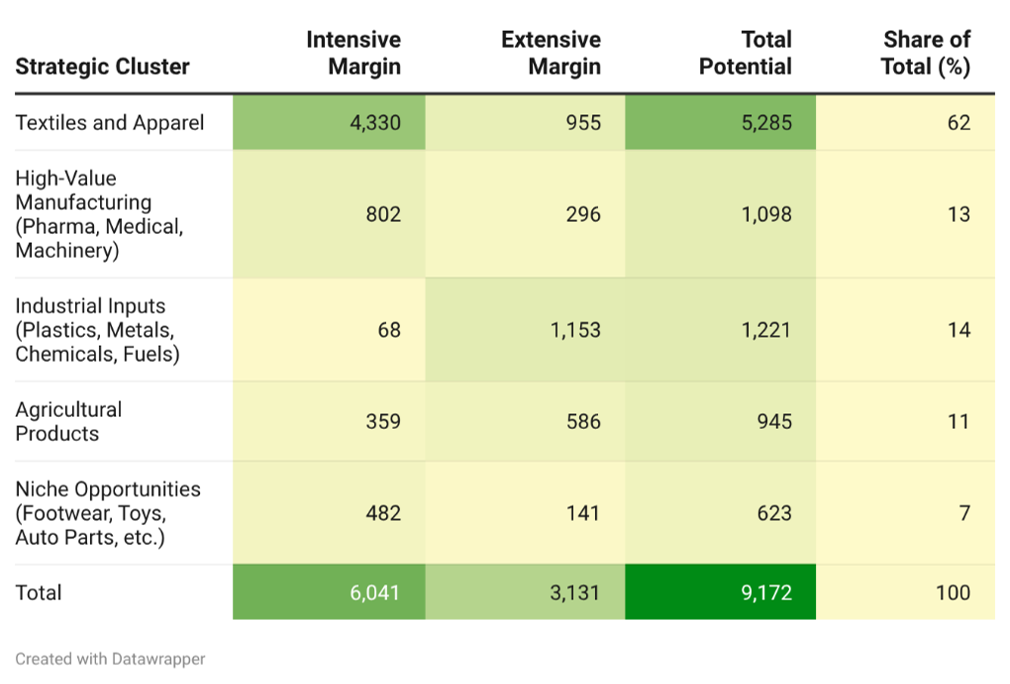
Figure a: Pakistan’s Export Potential by Strategic Cluster (Values in USD Million)
Note: Potential estimates assume full diversion of global trade flows to the bilateral corridor. Actual outcomes will depend on enabling factors. The realistic near‑term potential (10-15% capture) would be lower.
On the import side, the EAEU can supply nearly all of Pakistan’s crude oil, natural gas, diesel, fertilisers, polymers, and base metals.
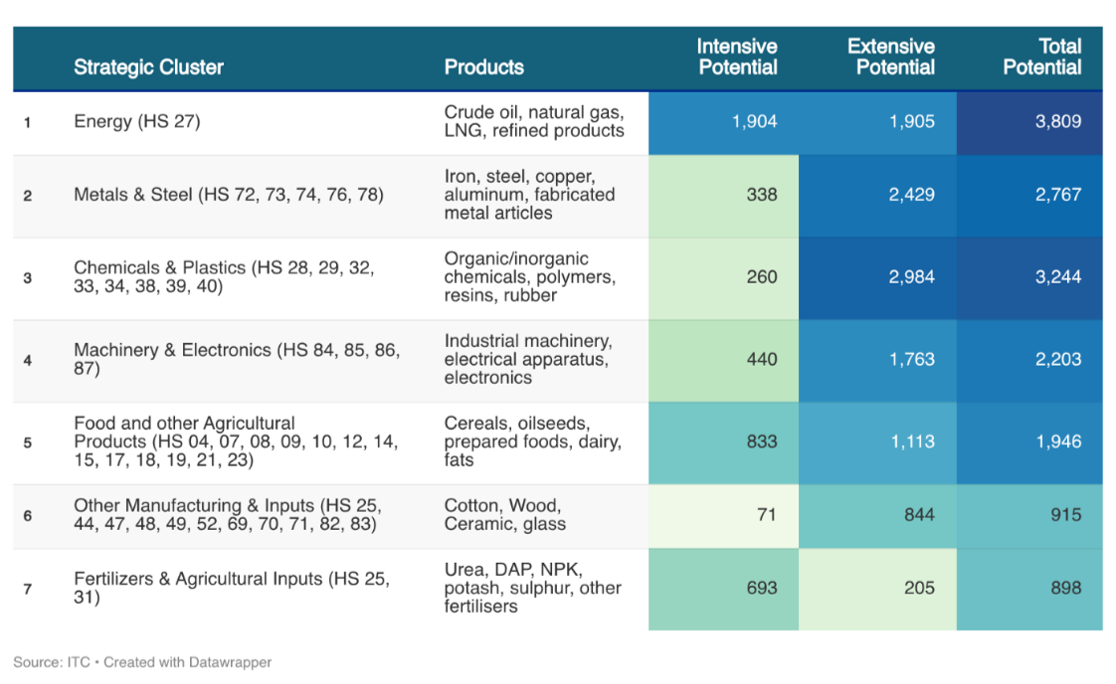
Figure b: Pakistan’s Import Potential by Strategic Clusters (Values in USD Million)
Note: Potential estimates assume full diversion of global trade flows to the bilateral corridor. Actual outcomes will depend on enabling factors. The realistic near‑term potential (10-15% capture) would be lower.
Three operational shortcomings block the flow.
- First, no reliable cross‑border payment channel exists under sanctions. Banks hesitate to process transactions to Russia and Belarus. Workarounds through Dubai, Hong Kong, or cryptocurrency are inefficient and inaccessible to most firms.
- Second, no integrated logistics corridor for perishable goods has been developed. The overland route through Afghanistan is closed. The maritime route is slow and expensive. A new road corridor through Iran opened in April 2026, but it is not yet a fully functional
- Third, mutual recognition of sanitary and industrial standards has not been agreed. Every shipment faces fresh inspections.
A phased roadmap is recommended
The report recommends action across three time horizons. Each horizon addresses specific constraints.
Immediate (0‑24 months)
- Establish a government‑backed non‑dollar settlement channel using rupee‑ruble or rupee‑yuan accounts at designated public banks
- Back exports with export credit guarantees to de‑risk transactions for small and medium sized enterprises
- Reduce the LNG tariff on imports from 11 percent to 2‑3 percent
- Negotiate a limited preferential agreement covering textiles, agricultural products, and other low hanging fruits with high export potential
- Publish clear customs procedures for the Pak‑Iran Transit Corridor and negotiate transit agreements with Iran and Turkmenistan
Medium‑term (3‑5 years)
- Complete the Uzbekistan‑Afghanistan‑Pakistan railway line to cut transit time from 35‑45 days by sea to 20‑25 days by rail
- Negotiate mutual recognition agreements for phytosanitary, pharmaceutical, and industrial standards
- Formalise the role of the Belarusian Universal Commodity Exchange as a secure settlement platform
- Establish a joint working group with central banks to resolve operational payment issues
Long‑term (5+ years)
- Pursue a comprehensive free trade agreement covering all goods, services, investment, and government procurement
- Promote joint ventures in textiles where EAEU members supply machinery and technology and Pakistan contributes raw cotton and labour.
- Promote joint ventures in agricultural machinery by drawing on EAEU members with manufacturing capacity for tractors and harvesters to support local assembly in Pakistan.
- Position Pakistan as a regional energy trading hub by upgrading refining capacity and securing long‑term supply contracts with Russian and Kazakh producers
Political will is present
Kazakhstan and Uzbekistan sent their presidents to Islamabad in early 2026. Pakistan and Armenia established diplomatic relations. The EAEU and Pakistan agreed in April 2026 to form a joint feasibility study group. What remains is the detailed work of implementation. This report provides the evidence and the roadmap for that work. The cost of inaction is continued dependence on a single maritime chokepoint for energy and a single export market for manufactured goods. However, the cost of building the necessary infrastructure is manageable. The choice is whether to start now or to wait until the next crisis makes the decision unavoidable.
The PBC is a private sector not-for-profit advocacy platform set-up in 2005 by 14 (now 100+) of Pakistan’s largest businesses. PBC’s research-based advocacy supports measures which improve Pakistani industry’s regional and global competitiveness. More information about the PBC, its members, objectives and activities can be found on its website: www.pbc.org.pk
Download