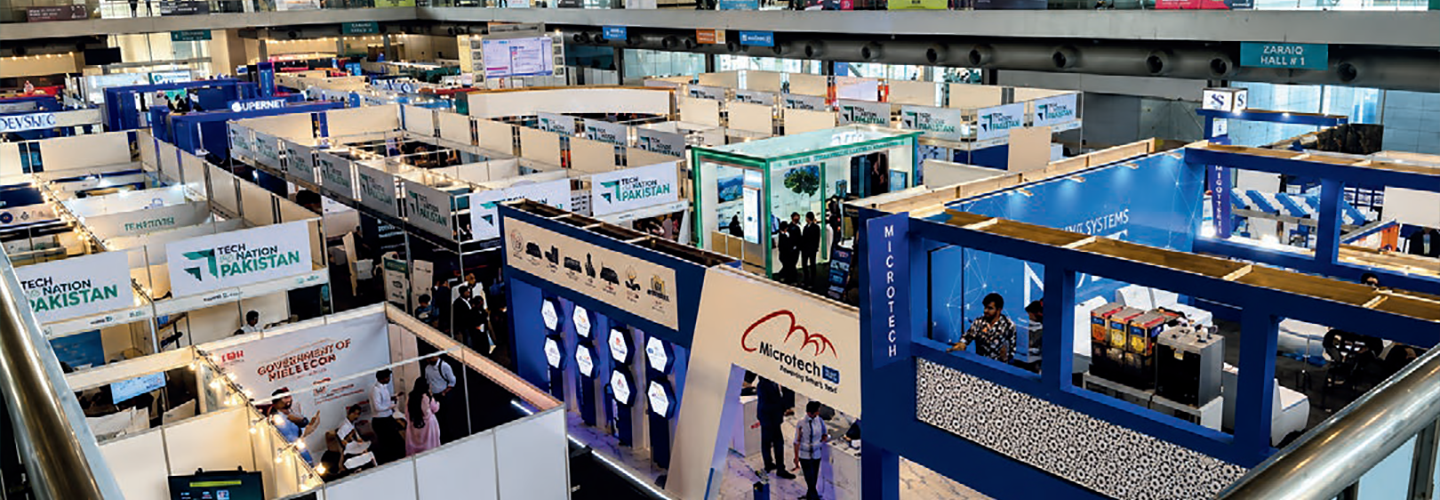
Pakistan’s IT and ITeS sector has seen unprecedented growth over the last few years. The sector has sustained double-digit export growth despite macroeconomic crisis, hyperinflation and the onset of AI-driven disruption to the global IT services industry. The export of computer services grew from USD 1.67 billion in FY2021 to USD 3.24 billion in FY2025 (a 94 percent increase) while the broader ICT sector reached USD 3.81 billion. The sector constituted 45 percent of Pakistan’s total services exports, generating a trade surplus of USD 2.4 billion (the highest of any services category) making the policy case for treating it as a strategic national priority unequivocally.
USD 3.24B
Computer Services exports FY2025
SBP formal bank-channel up from USD 1.67B in FY2021 |
USD 3.81B
Total ICT exports FY2025
Computer + Telecom + Information Services |
USD 2.4B
IT trade surplus FY2025
Highest of any services category |
45%
ICT share of total services exports
11.8%
ICT share of total exports
Fastest-growing export category |
However, this favorable trend is vulnerable to a structural fragility that this study has documented in detail. The growth is concentrated in the two service categories most sensitive to AI displacement. This is illustrated by the 41 percent drop in the median per-transaction value of freelance earnings between FY2021 and FY2025 (from USD 106 to USD 63) despite 114.6 percent growth in total freelance exports. The sector has an overwhelmingly micro-scale corporate base, with only 12 publicly listed IT companies out of 33,172 registered with SECP as of 31 December 2025 (0.04 percent). Out of an annual cohort size of approximately 43,000 IT graduates in Pakistan, only 10 to 12 percent are considered immediately employable without significant remediation, particularly to develop their soft skills. The regulatory, financial and infrastructural environment that would allow the sector to transition from price-arbitrage services to higher-value, AI-resilient capability centers is either absent or not functional in practice. This study identifies and discusses the constraints and suggests remedial action.
This study draws on: transaction-level SBP Balance of Payments data for FY2021–FY2025, the SECP database of registered IT companies; IGNITE programme data; HEC enrolment and graduate statistics, a structured survey of senior executives, stakeholder interviews and focus group discussions with freelancers, startups and captive office operators. The study identifies seven structural challenges and provides a set of policy responses, under the SCALE framework, designed to address them.
Sector Size, Structure and the Measurement Gap
Pakistan is a sizable global exporter of ICT services and the fastest-growing component of its own services export portfolio. The sector’s true size, however, is materially larger than official figures capture.
The SBP figure of USD 3.24 billion cannot be treated as a comprehensive measure but rather a base figure. Findings from this study indicate that actual IT-related earnings (including flows classified under personal remittance codes and revenues from foreign-registered Pakistani-founded firms) may be closer to USD 5 billion or more. The gap is not indicative of a coverage gap in total foreign exchange inflows but rather it suggests a classification issue within the Balance of Payments. This insight is extremely important for policy because currently, incentive programmes, PSEB registration benefits and sector-specific support are calibrated against the IT export classification rather than aggregate inflows.
A critical analytical finding of this study is the structural composition of these exports. Freelance transactions constitute 90.8 percent of all recorded IT export entries (2.17 million of 2.39 million in FY2025) yet generate only 24.1 percent of total value[1].
The average software consultancy transaction is worth USD 12,618 while the average freelance transaction is worth USD 359 a ratio of approximately 35 to 1 by consultancy value, and 88 to 1 when compared against the average software export transaction of USD 31,699. The freelance distribution reveals an alarming dichotomy: 434,000 transactions (20 percent of the total) were below USD 18 each in FY2025, while the maximum recorded single transaction was USD 5.57 million. The average earnings floor for entry-level freelancers has shrunk significantly due to the proliferation of AI tools, while a small upper cohort of high-value practitioners captures disproportionate gains. The sector is stratifying and the distance between the two tiers is widening.
Seven Structural Constraints: Diagnosis
This study identifies seven interconnected challenges. These challenges do not exist in isolation and resolving any one of them without addressing foundational prerequisites has limited impact.
- Human Capital: Quality, Leadership and the Talent Drain: Only 10 to 12 percent of Pakistan’s 43,000 annual IT graduates are immediately employable. The binding deficit is not technical capability but soft skills, professional conduct, client communication and reliability. No programme currently produces executives capable of scaling companies internationally, or cross-disciplinary profiles combining technology with domain expertise in finance, healthcare or legal services. Women represent only 21 percent of STP workers, and just 38,000 of 2.32 million registered freelancers with bank accounts are women, a growth capacity failure, not only an equity one.
- Tax Architecture and Regulatory Design: The tax and banking architecture functions as a structural disincentive. No statutory distinction exists between a gig worker and a remote employee. FBR audit behavior treats legally exempt IT export income as contestable. Internet services carry a 34 percent effective tax. Import duties on laptops and cloud infrastructure taxes raise input costs on an export sector whose outputs are nominally incentivized.
- Banking and Payments: The banking framework makes offshore retention the rational decision. There is no mechanism to hold dollar balances or accept card-based international payments through Pakistani banks. IT firms with stable USD revenues cannot access working capital because banks require physical collateral and do not accept software assets. FDI approval timelines exceed twelve months, and regulatory restrictions have resulted in the collapse of startup funding.
- Ecosystem Gaps: Infrastructure and Data: Pakistan has only one to two Internet Exchange Points, making fixed broadband cost USD 0.53 per Mbps—6.6 times higher than India and 53 times higher than Romania. Pakistan’s ICT access index ranks 128th of 139 economies globally (WIPO GII, 2025). The Special Technology Zones Authority framework has been identified by board-level participants as the most prominent policy implementation failure in the sector’s recent history. Data fragmentation across SBP, SECP, PSEB, HEC and FBR compounds these gaps.
- Products, Services, and Export Diversification: Pakistan’s export base is almost entirely cost-arbitrage services with no meaningful domestic product base. Government-owned IT entities develop software for government departments outside competitive procurement, displacing private firms from the contracts that serve as the capability-building and reference-deployment pathway to international markets. Pakistan is ranked 17th globally in mobile app downloads (1.42 billion in 2024) yet this segment is a blind spot in industry and policy. Space-tech, 5G-enabled services and semiconductor chip design remain unrecognized as export frontiers.
- Country Brand and Market Access: Pakistan does not appear in Everest Group, Hackett Group or comparable IT delivery location assessments. It is not that it is evaluated and found inadequate, it is just not in the consideration set. Pakistan has very few captive ICT operations against India’s 1,700+, which generate USD 64.6 billion annually. Country-of-origin risk filters screen Pakistan out on political stability, cybersecurity posture and data protection grounds regardless of technical capability. Export concentration in the US and UK creates vulnerability to their policy shifts.
- AI Transition: Displacement, Pricing Disruption, and Governance Vacuum: Pakistan faces two distinct AI challenges. First, workforce disruption: the sector is concentrated in staff augmentation and BPO, the categories most directly displaced by AI tools, and the 41 percent fall in median freelance transaction value is consistent with commoditization already underway. Second, an AI development failure: Pakistan has not built the compute infrastructure, data governance framework or regulatory environment to produce AI products. R&D expenditure stands at 0.16 percent of GDP (ranked 92nd globally). Failing on the first means losing the export base Pakistan has built; failing on the second means being permanently positioned as a consumer of AI rather than its producer.
What Needs to Be Done:
This study identifies 45 recommendations across seven challenge clusters, organized under the SCALE framework: Skills and Talent Pipeline Transformation, Captive and Corporate Attraction Strategy, Access to Markets and Finances, Legal and Regulatory and Digital Governance Reform, and Ecosystem and Startup Infrastructure. Recommendations are sequenced across three implementation horizons.
- Immediate Foundations (short-term): gazette a statutory freelancer definition; mandate SBP multi-currency receiving accounts; establish a 48-hour remittance processing standard; introduce IT Export Dollar Accounts; enact a statutory FBR safe harbour on exempt IT export income; launch a 5-year cross-party IT sector policy stability compact; deploy a dedicated captive attraction function engaging Everest, Hackett and Gartner; establish a Pakistan Startup Fund with a 30-day decision SLA; and create a 60-day FDI fast-track channel.
- Structural Reforms (medium-term): reform PPRA procurement to include an IT stream with a 25-percent SME quota; introduce a 20-percent domestic price preference for government IT procurement; phase government-owned IT entities out of commercial contracting; enact the Personal Data Protection Act and initiate the EU adequacy pathway; reduce internet effective tax from 34 percent to 10 percent or below; establish a Global Tech Landing Pad; reform university curricula with 30-percent industry co-design and mandatory practicums; and introduce per-hire grants of 15-percent salary reimbursement.
- Transformation Investments (long-term): develop a National AI Strategy with sovereign compute infrastructure; establish a Yozma-style matched VC fund (USD 200M); build six IXPs nationwide with an open-access fiber backbone; create chip design labs at NUST, GIKI, UET and NED; and develop the Pakistan Stack—an open digital identity layer, payment rail and public API framework to create domestic reference deployments that can be commercialized globally.
The data analysed for this study makes the strategic imperative clear. Pakistan has built a legitimate and growing IT export base under conditions that have constrained it at every stage. The sector’s next growth phase requires moving from informal and fragmented participation in global IT markets to structured, policy-enabled, high-value delivery before AI displacement and market-access barriers permanently foreclose that transition.
[1] This number represents bank remittance-receipts rather than distinct individuals, consistent with the official SBP methodological position. The 2.17 million counts therefore sets an upper bound, not a headcount of freelancers.
The PBC is a private sector not-for-profit advocacy platform set-up in 2005 by 14 (now 100+) of Pakistan’s largest businesses. PBC’s research-based advocacy supports measures which improve Pakistani industry’s regional and global competitiveness. More information about the PBC, its members, objectives and activities can be found on its website: www.pbc.org.pk
Download