This study, “Trade Routes Connecting Pakistan, Afghanistan, Central Asia, Russia & Europe,” is based not only on an extensive review of secondary data, but more importantly on analytical assessment of regional connectivity patterns, trade corridors, and infrastructure linkages between Pakistan and its neighboring regions.
The study examines the major trade corridors linking Pakistan with Afghanistan, the Central Asian Republics (CARs), Russia, and beyond into Europe. It identifies key border crossings, transit routes, and road networks that facilitate regional trade flows, while also highlighting existing bottlenecks and inefficiencies affecting cross-border connectivity.
As part of this analysis, the study explores opportunities to enhance trade integration with Afghanistan, Central Asian Republic, (Turkmenistan, Uzbekistan, Tajikistan, Kazakhstan, Kyrgyzstan) Russia, and Europe focusing on both current infrastructure and future connectivity prospects. It also evaluates the long-term potential of developing these corridors into a more efficient and integrated regional trade network. The study is undertaken within the broader framework of promoting Pakistan’s role as a regional trade and transit hub. By identifying strategic opportunities and constraints, it aims to provide actionable insights and policy recommendations to strengthen connectivity, improve transit trade efficiency, and support regional economic integration between Pakistan, Afghanistan, Central Asia, Russia, and Europe.
Demographic and Economic Foundations
Pakistan’s large and growing population—exceeding 251 million in 2024—provides both a substantial domestic market and a labor base that can support trade-led growth. Although population growth has gradually moderated, urbanization is accelerating, reinforcing demand for infrastructure, logistics, and trade-related services. Economically, Pakistan showed signs of stabilization in 2024, with a GDP of US$380 billion and growth recovering to 2.26 percent, alongside a sharp decline in inflation. However, persistent trade deficits underscore structural weaknesses in export competitiveness and highlight the importance of leveraging transit trade as a complementary growth channel.
Pakistan–Afghanistan Trade Routes Connecting Major Cities
Pakistan’s overland corridors with Afghanistan serve as critical gateways for bilateral and regional trade, enabling access to Central Asian markets. Key routes—including Peshawar–Kabul, Ghulam Khan–Kabul, Quetta–Kandahar, Kamr-din-karez–Moqar and Angoor Adda–Ghazni—enhance cross-border connectivity, strengthen trade integration, and promote regional economic cooperation. Major border crossings such as Torkham, Chaman, and Ghulam Khan link Pakistani cities to key commercial hubs like Kabul, Kandahar, and Herat, facilitating efficient transit trade and supporting Pakistan’s role as a regional trade hub.
Figure: 1 Map of Pakistan’s Trade Routes to Afghanistan
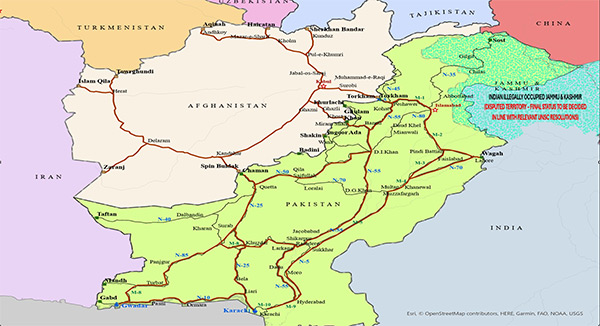
Source: USAID| PREIA -Pakistan Regional Economic Integration Activity
Pakistan Transit Trade Corridor to Central Asia Via Afghanistan
Pakistan’s transit trade routes to Central Asia, using Afghanistan as a land bridge, are vital for enhancing regional connectivity and expanding economic opportunities. Key corridors—including Torkham, Ghulam Khan, Chaman, Badini Trade Terminal, and Zhob (Kamr-ud-Din Karez)—link Pakistan with major Afghan hubs such as Kabul and Kandahar, from where road networks extend to Turkmenistan, Uzbekistan, Tajikistan, Kazakhstan, and Kyrgyzstan. These routes facilitate the movement of goods, strengthen Pakistan’s regional trade presence, and support broader economic integration across South and Central Asia.
Pakistan– Afghanistan–Tajikistan Transit Trade Route
The Pakistan–Afghanistan-Tajikistan transit trade route provides an important regional trade link. The primary route originates in Peshawar, enters Afghanistan via the Torkham border, passes through Kabul, and continues to Sher Khan Bandar before crossing into Tajikistan and reaching Dushanbe. An alternative route runs from Pul-e-Khumri to the Hairatan border, transits through Uzbekistan, and then connects to Tajikistan, while also leading to Dushanbe as an alternate. Together, these routes enhance bilateral and regional trade connectivity and provide Pakistan with strategic access to Central Asian markets.
Figure: 2 Map of Pakistan’s Trade Routes to Tajikistan Via Afghanistan
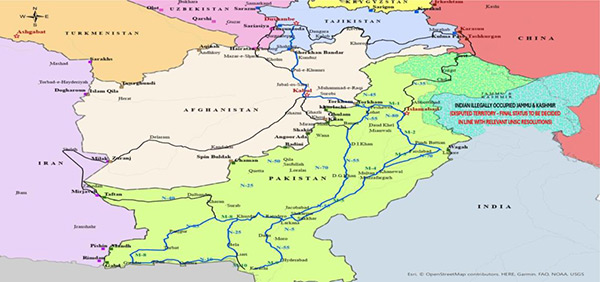
Source: USAID | PREIA
Export Opportunities for Pakistan in the Central Asian Republics and Russia
Untapped Market Potential
The analysis reveals significant gaps between Central Asian Republics’ imports from the world and from Pakistan, indicating substantial untapped export potential. Despite strong global export performance, Pakistan’s market share in CARs remains limited, particularly in high-demand products.
High-Potential Product Categories
Key export opportunities exist in pharmaceuticals, citrus fruits, rice, potatoes, sugar, textiles, sports goods, soaps, and processed foods. Products such as medicaments, mandarins, rice, and sugar show high demand in the CARs markets, while Pakistan has proven export capacity in these sectors.
Priority Markets in Central Asia
Uzbekistan and Kazakhstan emerge as the largest and most promising markets, followed by Tajikistan and Kyrgyzstan, where Pakistani exports have shown gradual growth. Turkmenistan, although smaller, also presents opportunities in selected products.
Pakistan’s Export Opportunities, Potential, and Comparison of Key Economic Indicators with Central Asia and Russia (2024)
Pakistan’s exports to the Central Asian Republics (CARs) remain limited despite considerable potential. The estimated export potential is about $436 million, while current exports are only around $202 million, indicating a large untapped market. Among the CARs, Kazakhstan and Uzbekistan offer the greatest opportunities due to their larger economies, higher purchasing power, and sizeable populations. Beyond Central Asia, Russia represents an even larger market in the Eurasian region, with a GDP of about $2.09 trillion, a population exceeding 143 million, and relatively high per capita income, making it an important potential destination for Pakistan’s exports.
Table: 1 Pakistan’s Export Potential and Key Economic Indicators (2024)
| Countries |
Pakistan Exports ($ in Million) |
Pakistan Potential Exports ($ in Million) |
GDP ($ in Billion) |
GDP PCI USD |
Population (Million) |
| Pakistan |
… |
… |
380.04 |
1,512.50 |
251.27 |
| Uzbekistan |
103.65 |
187.00 |
101.81 |
2,800.03 |
36.36 |
| Kazakhstan |
41.87 |
210.00 |
288.44 |
14,006.97 |
20.59 |
| Tajikistan |
41.13 |
25.00 |
13.72 |
1,295.38 |
10.59 |
| Kyrgyzstan |
14.24 |
13.00 |
16.10 |
2,240.27 |
7.22 |
| Turkmenistan |
1.82 |
19.00 |
65.96 |
8,800.88 |
7.49 |
| Russian Federation |
68.64 |
142.00 |
2,091.56 |
14,442.46 |
143.53 |
| Source: ITC & WDI |
Challenges
Worsening Internal Security Conditions in Pakistan
Border Provinces, particularly Khyber Pakhtunkhwa and Balochistan, have experienced rising security challenges due to increased militant activity. This has disrupted trade routes, heightened transportation risks, and increased the cost of doing business, negatively affecting trade with Central Asia.
Cross-Border Tensions and Regional Security Risks
Ongoing tensions between Pakistan and Afghanistan have resulted in periodic border closures, causing delays and supply chain disruptions. Persistent security concerns and the presence of militant groups continue to undermine the reliability of regional trade corridors.
Collapse of Transit Trade and Regional Connectivity
Transit traffic through Pakistan to Afghanistan and Central Asia has declined sharply, weakening Pakistan’s credibility as a transit hub. The near halt in trade with Afghanistan has further encouraged regional partners to seek alternative routes.
Loss of Export Markets and Trade Volumes
Trade disruptions have led to a significant decline in Pakistan’s exports to Afghanistan and Central Asia, particularly in cement, pharmaceuticals, and perishable goods. Export volumes have fallen sharply, reducing Pakistan’s presence in regional markets.
Payment and Financial Transaction Barriers
Pakistani exporters face serious payment constraints due to restrictions on the repatriation of foreign currency. The current limit of USD 5,000 per individual creates major difficulties for businesses involved in large-value transactions.
Recommendations
Strengthening Transit Trade Governance
Establish a National Transit Trade Coordination Mechanism under a central authority to ensure alignment among federal and provincial stakeholders, harmonize transit regulations, and streamline decision-making. A clear institutional ownership will reduce fragmentation and improve efficiency in transit operations.
Improving Border Management and Customs Facilitation
Upgrade border infrastructure at key crossings such as Torkham, Chaman, and Ghulam Khan, as well as emerging terminals like Zhob Kamr-Ud-Din Karez and Badini Trade Terminal. Introduce risk-based inspections, digital customs clearance, pre-arrival processing, and electronic documentation to reduce transaction costs and improve corridor reliability.
Upgrading Transport and Logistics Infrastructure
Enhance intermodal connectivity and logistics services by upgrading roads linking border terminals to national highways and ports. Invest in rail freight, dry ports, and logistics hubs along transit routes to support bulk and long-haul cargo movement. Public–private partnerships can accelerate these investments.
Enhancing Regional Agreements and Trade Diplomacy
Strengthen bilateral and regional transit agreements with Afghanistan, Central Asian Republics, Iran, China, Turkey, and Russia. Address non-tariff barriers, promote mutual recognition of standards and transit documents, and position Pakistan as a reliable regional transit partner.
The PBC is a private sector not-for-profit advocacy platform set-up in 2005 by 14 (now 100+) of Pakistan’s largest businesses. PBC’s research-based advocacy supports measures which improve Pakistani industry’s regional and global competitiveness. More information about the PBC, its members, objectives and activities can be found on its website: www.pbc.org.pk
Download


